
UNDERSTANDING FLOOD BARRIER TESTS
Flood Barrier Leakage Rates: What the Numbers Mean
The small leakage figure on a report needs context. Check the units, reference length and exposure time before applying it to your opening.
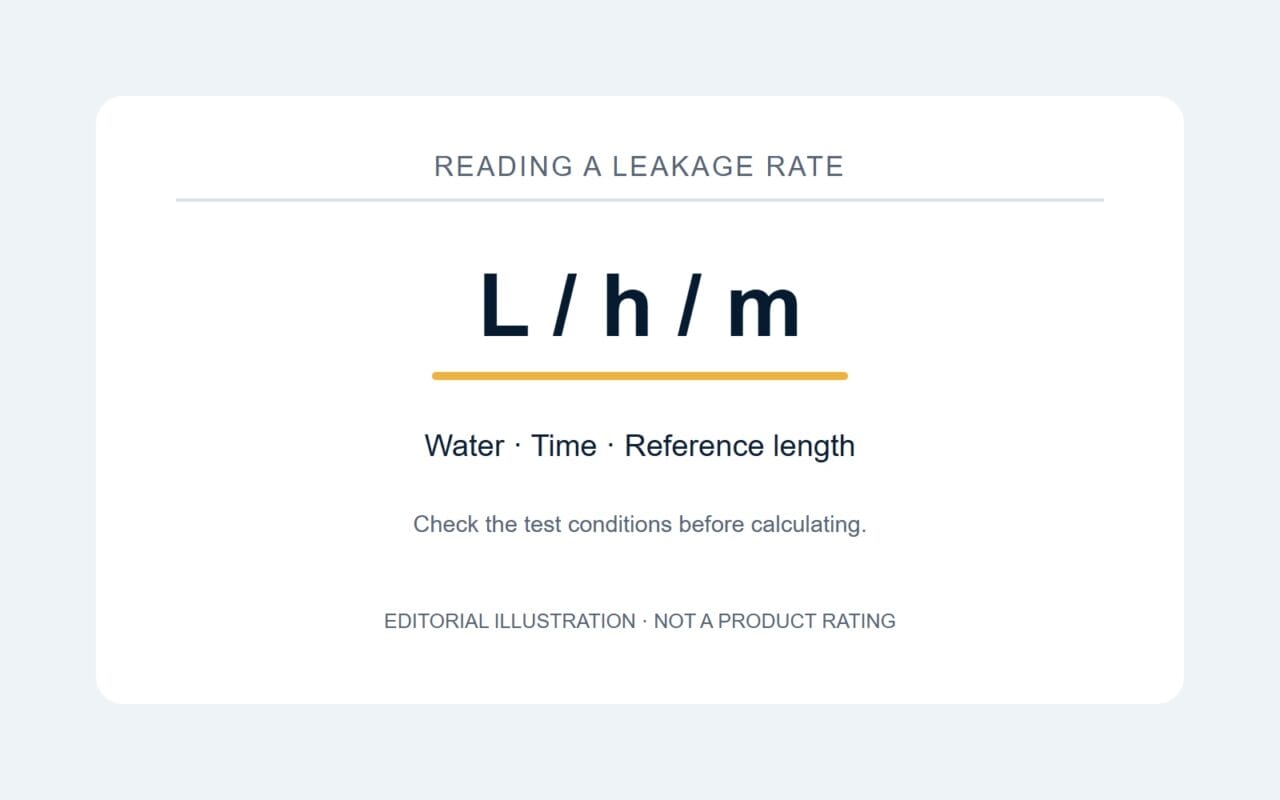
A flood barrier should not be assumed to be completely watertight. A water-test report may record leakage even when the sample meets the stated test requirement. Before buying, check how much water was measured, the conditions of the test and how the result applies to your proposed opening.
In a public discussion about making temporary door barriers waterproof, a homeowner was trying to seal panels against irregular surfaces. Getting a panel into position was only part of the problem. For a manufactured system, the next step is to ask what evidence supports the seal and the complete installed arrangement.
Start with the measured result
Our published DSC-095 performance report gives a useful example. Page 5 records a static-water test at 1.50 m depth for 60 hours, with leakage reported as 0.51 L/h/m. The tested sample was 3,000 mm wide and 1,600 mm high, as identified on pages 2–3.
The result is marked as meeting the requirement stated in that report, although the measured leakage is not zero. The document describes a commissioned witnessed test referencing PAS 1188-4:2014 and client requirements. It does not establish a leakage rating for every Eudore size or site arrangement.
When comparing offers, ask for the page with the measured result. Then check the water depth, exposure time, sample dimensions and support arrangement alongside it. A cover page or a certificate title gives you much less to work with.
Read the whole unit, including the last “per”
L/h means liters per hour. L/h/m means liters per hour per meter of a defined reference length. Those figures cannot be compared directly until you know which length the report uses.
Does that meter refer to the opening width, the wetted sealing perimeter or another length defined by the test method? Ask the supplier to identify it. A unit label on its own does not settle the question.
FEMA Technical Bulletin 3, section 6.8.3, discusses leakage around flood shields using the wetted perimeter. That guidance concerns non-residential dry floodproofing. It illustrates why the reference length matters; it does not define the denominator in every manufacturer’s report or approve a residential installation.
For the DSC-095 figure above, request clarification of the normalization length before multiplying it by your garage width. Also check whether the reported value is an average over the test, a maximum or another stated measurement.
What a small rate adds up to
Here is a separate arithmetic example. Suppose a report defines its rate as 0.5 L/h/m, the applicable reference length is 4 m, and the rate stays constant for 6 hours:
0.5 × 4 × 6 = 12 liters.
This is an invented calculation for explaining the units, not an Eudore test result or a prediction for a customer’s property. Under those assumptions, the accumulated amount is 2 liters after one hour, 6 liters after three hours and 12 liters after six hours.
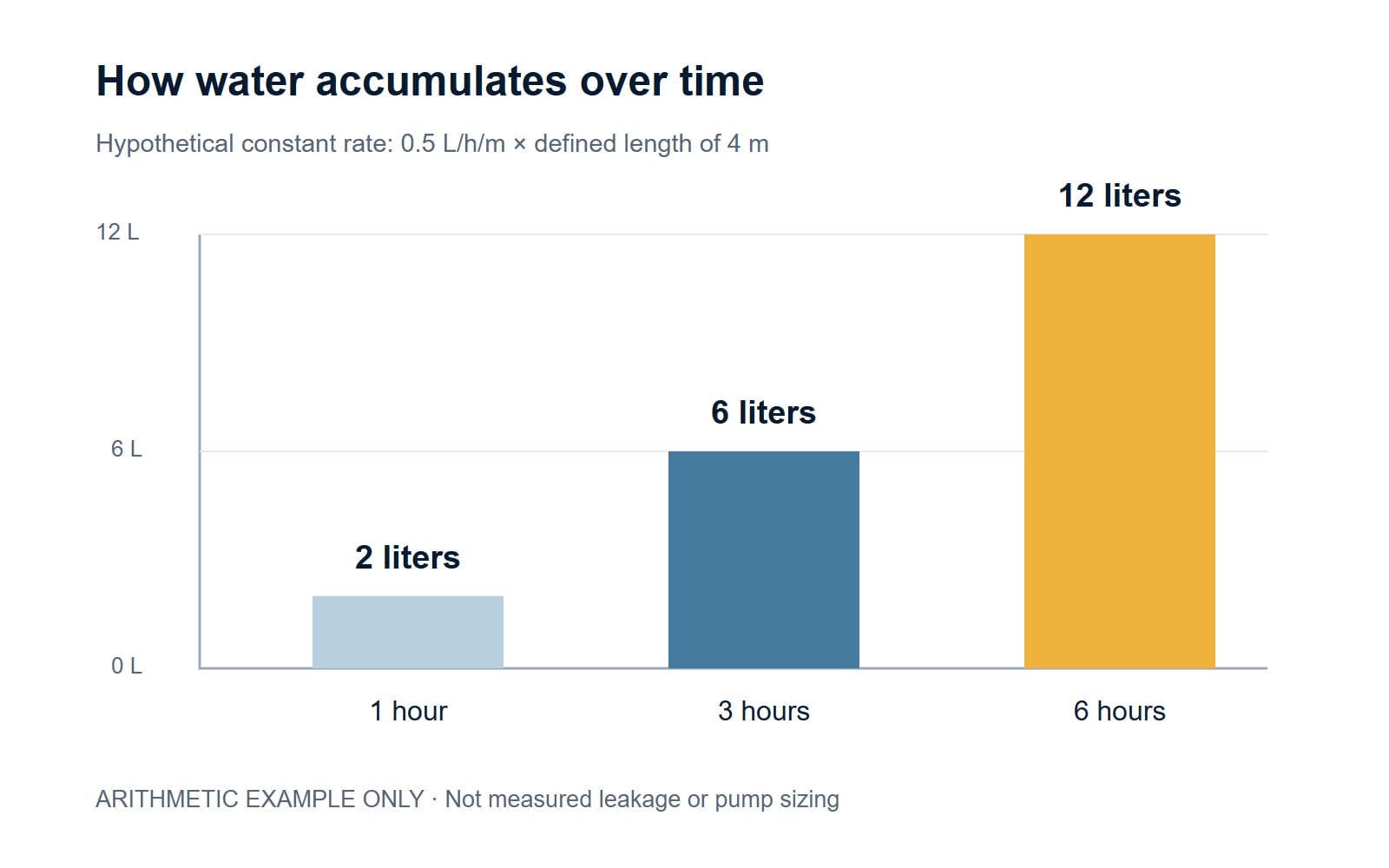
The calculation becomes useful only after the report’s terms are clear. Real water levels and leakage can change during an event, and a different installation may behave differently from the tested sample.
Keep the leakage figure in the wider site plan
Water collected inside a barrier line may also come from rain, walls, the floor or connected drains. Our sewer-backflow guide covers the plumbing route separately. Do not put all of those sources into a single number labeled “barrier leakage.”
FEMA’s bulletin, sections 6.8–6.9, treats shield leakage, other seepage and interior drainage as connected design tasks. It also warns against relying on pumps as the sole means of meeting dry-floodproofing requirements. A site reviewer needs to consider collection, discharge, power and other inflows; the 12-liter illustration above is not enough to select a pump.
Four details to settle before ordering
For a useful comparison, ask each supplier the same questions:
- Which model, opening size, seals and supports were actually tested?
- What water depth and duration produced the quoted leakage figure?
- What does the unit’s reference length mean, and how was the result measured?
- Which installation and maintenance conditions must the proposed opening satisfy?
If a result is reported as zero, ask about the measurement method and reporting limit as well. Read it within the test conditions. It should not become a promise that every installation will stay dry indefinitely.
For the broader document comparison, see our aluminum flood barrier quality guide. For an Eudore proposal, send the opening dimensions and photographs, then ask us to identify the applicable report and explain the leakage-rate basis. You can request a document review, begin with the technical resource library, or review the product configuration and purchase details.
Continue your research
Related flood protection reading.
Read a connected guide, comparison or project insight before choosing a protection route.
Get a custom recommendation
Tell us about the opening you need to protect.
Share the opening type, clear width, target flood height and photos. The team will review the details before recommending a configuration.