
DIY & MANUFACTURED FLOOD BARRIER COMPARISON
DIY Plywood Flood Barriers vs Aluminum: What to Check
Plywood and aluminum proposals need the same opening-specific review. Compare the design, supports, seals, deployment plan and complete cost before deciding.
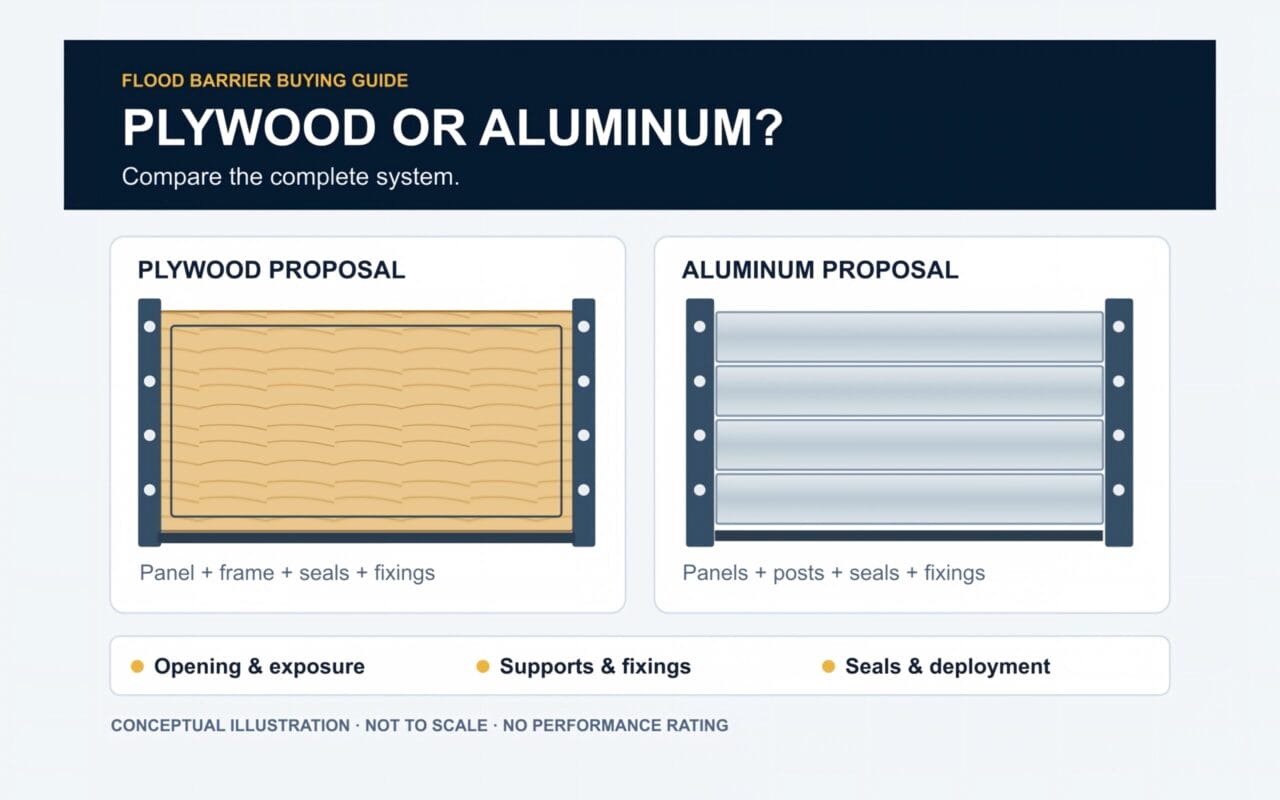
Marine-grade plywood can have a role in a designed flood shield for a small opening exposed to short-duration, shallow flooding. A DIY plywood flood barrier still needs a suitable panel, supports, fixings and seals matched to the opening and expected loads. A coating or board thickness alone does not establish flood protection. Compare the complete proposed arrangement with a documented manufactured system before deciding.
Why do homeowners consider plywood flood barriers?
In an April 2024 Garage Journal discussion, a homeowner asked about coating plywood panels intended for exterior door openings. The poster later described proposed bolts and gaskets, concerns about swelling, and previous water levels around two feet or more. These were questions about a proposed DIY arrangement, not reported results from a verified flood test.
The useful buying question is broader than which coating to choose: who will check the complete shield and its connection to the building? A material purchase and an accepted opening-specific design are different stages of preparation.
Does FEMA say plywood can be used for flood shields?
Yes, within limits. FEMA P-936, section 3.5.2, discusses marine-grade plywood for limited applications involving small openings and short-duration, shallow flooding. It discusses reinforcement, storage-related warping and periodic examination. The publication identifies steel and aluminum for longer-duration exposure and larger shield arrangements.
This does not establish a safe thickness or water depth for a homemade panel. P-936 concerns floodproofing non-residential buildings; its material discussion is engineering context, not approval for a particular home or product. Ask a qualified reviewer to assess the proposed opening, exposure and supporting construction.
Does marine-grade plywood or a waterproof coating settle the question?
No. A panel’s material grade does not rate the assembled flood barrier. APA’s marine-grade plywood FAQ describes a defined veneer construction, an Exterior exposure rating and waterproof structural adhesive. It also explains that marine-grade plywood is not inherently chemically treated for decay resistance. These descriptions concern the wood panel, not the performance of a doorway shield.
For a plywood proposal, request the actual panel designation and the proposed finish details, including edges, holes and repair after damage. Ask the designer how the selected materials are used in the complete assembly. Do not choose a coating from an online recommendation and assume that it resolves structural capacity, mounting or leakage.
Why do the wall, anchors and panel movement matter?
FEMA’s Technical Bulletin 3, page 24, explains that flood shields must resist water loads across the shield and transfer them through mounting systems to the walls and foundations. This applies to the whole arrangement being assessed, rather than to the face material alone.
FEMA’s retrofitting guidance, section 5D, page 5D-24, also distinguishes panel stress from deflection and discusses connections and sealants. A panel can need further review even when a strength check appears satisfactory. For a buyer, ask how movement, support details and sealing are addressed together.
Give the reviewer photographs of the actual fixing areas and threshold. Identify loose finishes, damaged construction and uncertain substrates before fabrication. A photograph of another installation cannot confirm your wall’s capacity.
How should you compare plywood and removable aluminum barriers?
Use the same project information for both proposals. The following table lists questions to resolve; it is not a comparative performance test or a claim that every manufactured product is suitable.
| Decision | Plywood proposal | Aluminum proposal |
|---|---|---|
| Configuration | Who specifies the panel, frame, bracing and fixings? | Which model, panel section, posts and supports are quoted? |
| Design evidence | What assessment covers this opening and expected exposure? | Do calculations and applicable tests match the offered configuration? |
| Sealing | How are the perimeter, threshold and fixing penetrations detailed? | What seals, compression components and surface preparation are required? |
| Deployment | Who carries, positions and secures each panel before flooding? | Who inserts panels, fits supports and checks the deployed system? |
| Future use | What inspection, finish repair and replacement criteria apply? | What cleaning, seal inspection, storage and spare-part instructions apply? |
Read our aluminum flood barrier quality guide when reviewing material records, calculations and water-test evidence. Apply the same questions consistently rather than accepting a claim based only on thickness, weight or material name.
Is a DIY plywood barrier necessarily cheaper?
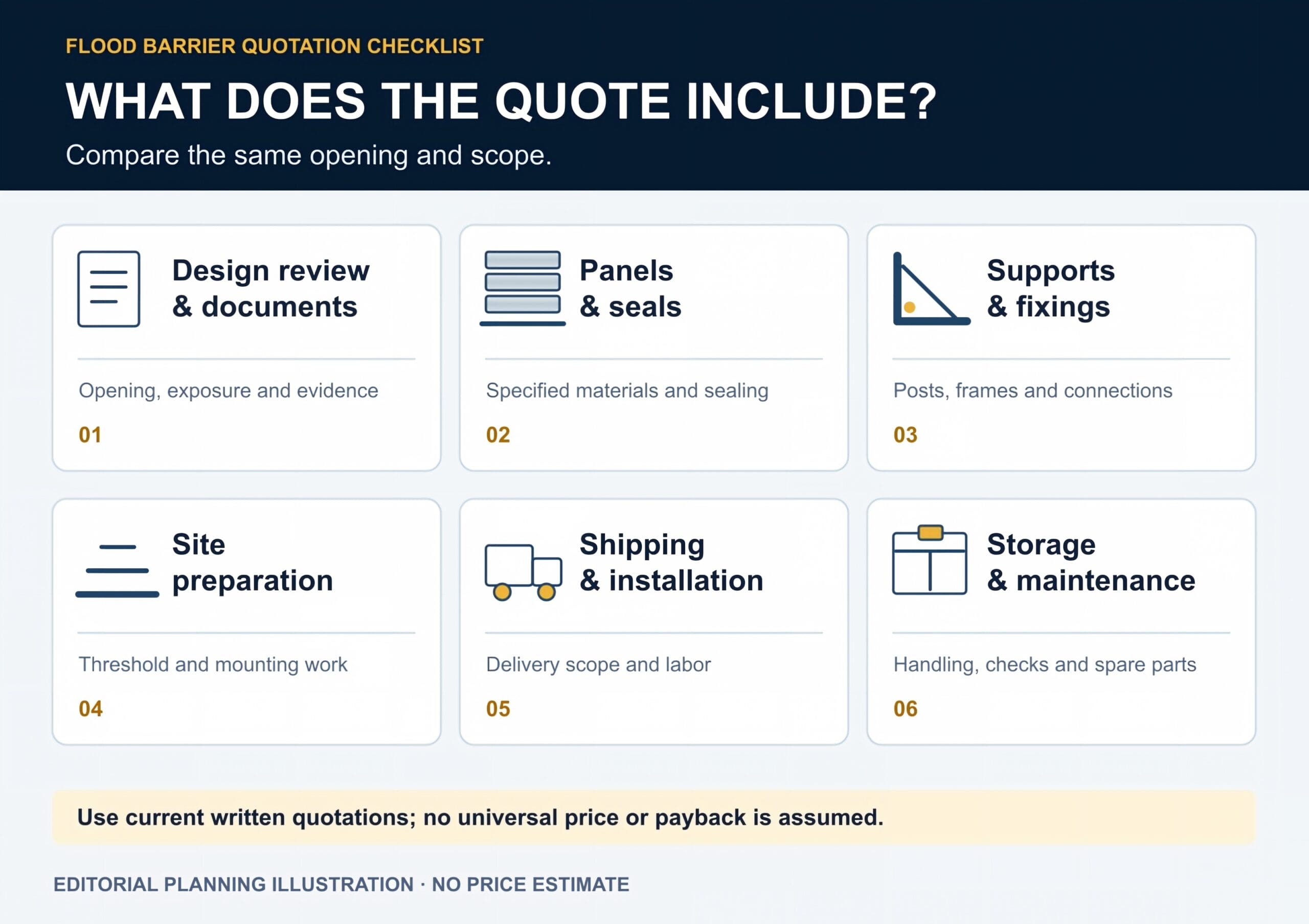
The sheet price alone cannot answer that. Prepare a complete written cost comparison for the same opening and protection requirement. Include design review, panels, finish, gaskets, fixings, supporting frame, threshold work, tools, installation labor, storage and anticipated inspections. Ask what replacement or rework is excluded.
For a manufactured quotation, also confirm shipping, destination charges, installation scope and replacement parts. Record which tasks you will perform yourself and which need a contractor. This guide does not assign a universal DIY cost, aluminum price or payback period; those require current quotations for the actual scope.
Does a manufactured barrier remove the need for site preparation?
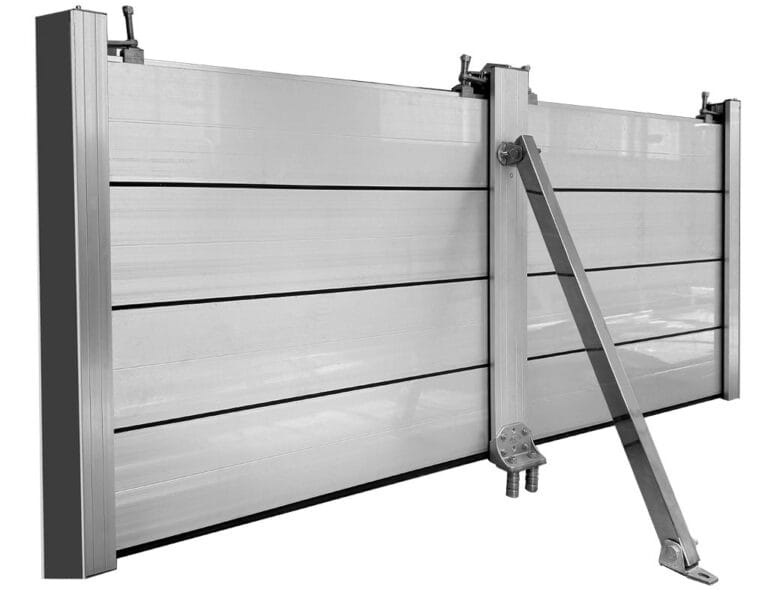
No. The Eudore installation manual separates permanent installation from temporary panel deployment and calls for review of the supporting surfaces and supplied configuration. Inspecting the threshold, mounting areas and seals remains part of the work.
Request the instructions for the system offered to you and rehearse deployment before flood conditions. Agree who will act when a warning arrives and how occupants will leave safely. Buying removable panels does not make an obstructed doorway a safe escape route, nor does it address every route through which water can enter.
Does installing a flood shield establish regulatory compliance?
No. Product selection is separate from the applicable building and floodplain requirements. Technical Bulletin 3, section 1.3, limits the NFIP use of dry floodproofing, including its use for new or substantially improved residential buildings in Zone A and buildings in Zone V. Do not treat this comparison as authorization to substitute doorway barriers for required elevation or other measures. Confirm the requirements for your property with the relevant authority and design professional.
What should you send before choosing a system?
Send the opening width, proposed protection height with its reference level, location, threshold photographs and close-ups of the side fixing surfaces. Describe previous flooding, expected duration, daily access and the people available to deploy the barrier. For an existing plywood proposal, include its drawing and material specification so the reviewer can identify unanswered questions.
Explore custom aluminum flood barriers for entrances, then request an opening and configuration review. Compare the accepted scope and supporting documents before approving an order.
Continue your research
Related flood protection reading.
Read a connected guide, comparison or project insight before choosing a protection route.


Get a custom recommendation
Tell us about the opening you need to protect.
Share the opening type, clear width, target flood height and photos. The team will review the details before recommending a configuration.